Press Kit

trove

Your bookmarks are your autobiography. Trove reads them back to you.

Read-only AI connection Search, never change
Captions YouTube transcripts Other audio is coming
125+ Senior registrations The System webinar
£79 Founding price/yr Locks forever, first 50
Validated by
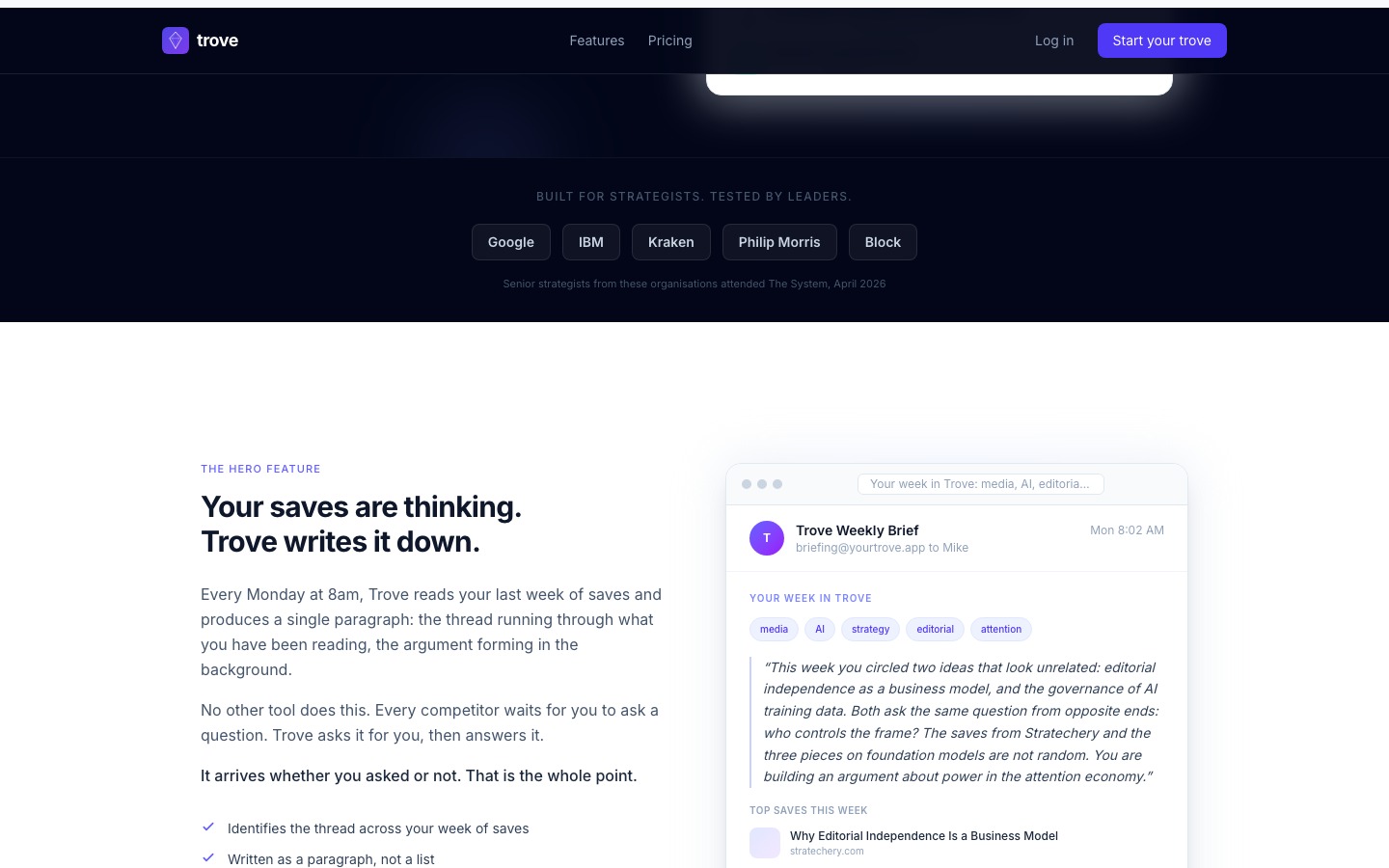
Google IBM Kraken Philip Morris Block
Senior strategists from these organisations attended The System, April 2026 — the event that introduced Trove to 125+ Heads of Strategy, Brand Directors, and CMOs.
The news hook

The infrastructure for reading on the internet collapsed. Nobody has rebuilt it properly yet.

Nov 2024

Omnivore shuts down. The leading open-source read-later tool, ~500K users. Acquired then closed within months.

Jul 2025

Pocket shuts down. Mozilla's read-later tool, the category default for 12+ years, ~40 million users. The biggest single displacement event in the market's history.

2025 onwards

Existing tools -- Readwise, Cubox, Raindrop, Matter -- absorb displaced users. None of them changes its fundamental model. All remain built around filing and retrieval, not synthesis.

May 2026

Trove. The first new entrant to position the category not as storage but as intelligence infrastructure. The market cleared. The gap is documented. The tool is live.

By the numbers
40M Pocket users displaced when the tool shut down in July 2025.
1 day The weekly briefing goes out on the day you choose. It is not fixed to Monday morning.
RSS A private podcast feed for the listen queue, plus a newsletter and RSS inbox.
£0 Price increase for founding members. The £79/yr rate is locked permanently.

Story arc

1
The displacement

The infrastructure for reading on the internet collapsed in twelve months

Pocket, which had been the default save-for-later tool for over a decade, shut down in July 2025, displacing around 40 million users. Omnivore, the open-source reader, had already folded in November 2024. In their place: a scatter of filing tools, read-later apps, and sync utilities. None of them asked what your saves meant. They were all happy to store; none of them could think.

2
The realisation

What you save is a portrait of who you are becoming

A bookmark is not just a URL. It is a micro-decision: this matters to me, now. A hundred bookmarks form a pattern. A year of saving reveals a sensibility, an argument, an identity under construction. The tools designed to help you save were only ever designed to help you find. The layer above them, the one that synthesises and reveals, did not exist.

3
The build

A save-it-for-later library, with the tools that read it back

Trove is a save-it-for-later app. On top of the library it adds a weekly briefing, Ask, Patina, semantic search, intents, highlights, a graph and Rediscover. Collections can be shared with an unlisted link. Claude and Cursor can connect with a read-only key, so they can search the library and cannot change it. There is also a save API.

4
The breakthrough feature

A weekly briefing on the day you choose, and Patina for the longer view

The briefing is weekly, on the day each person picks. The default day is Monday, and the job runs at 07:00 UTC, which is not local morning for every reader. It is written from recent saves. Patina shows the themes, sources and ideas someone keeps returning to, and how they shift. Trove does not publish a set of taste archetypes.

5
The audience

Built for Heads of Strategy and Brand Directors, validated with 125+ senior strategists

Trove's ICP is the Senior Strategist: Heads of Strategy, Brand Directors, fractional CMOs who treat cultural intelligence as a professional edge. The April 2026 webinar at The System attracted over 125 senior registrations, with 63 attending live. The audience included VPs and senior leaders from Google, IBM, Block, Philip Morris, and Kraken. Taste is a professional skill. Trove is where senior strategists develop it.
Story angles

Product

The AI that reads your bookmarks and writes your intellectual autobiography

Trove is a save-it-for-later app that also writes a weekly briefing from what you saved, on the day you choose. Ask can answer from that library, and a read-only connection lets Claude or Cursor search it without changing it. The hook is a library that stays useful after the tab is closed.

Market

After Pocket: where 40 million displaced readers should go next

Pocket died in July 2025. Omnivore folded in November 2024. Tens of millions of readers are now using tools that were not designed for them, or nothing at all. Trove is the first new entrant to propose a different model: not storage, but synthesis. A news-hook angle for any publication covering the collapse of the read-later market.

Competitive

A read-only connection, so an assistant can search a library and cannot edit it

Trove does not publish a competitive score. What it does ship is a save-it-for-later library, Ask, semantic search, and an MCP server with read-only keys. Matter and MyMind libraries can be imported. The competitive angle is access control: the assistant can read what you saved, and only changes the library if you allow it.

Culture

Taste is a professional skill. Trove is where senior strategists develop it

Cultural intelligence has always been described as intuition. Trove is built on the argument that it is a compounding, measurable, systematisable asset. The angle for culture, strategy, and leadership publications: what if your reading history was your competitive advantage?

Founder

BIMA 100 Tech Pioneer builds the cultural intelligence tool he needed

Michael Litman, BIMA 100 Tech Pioneer and published author (BCS, 2024), built Trove after 15+ years working in digital strategy and noticing that the tools designed to help him save were not designed to help him think. The weekly briefing, on a day the reader chooses, was built because he wanted it for himself.

Pitch this story

Three pre-written pitches for different beats. Copy and adapt.

Tech · Product · AI -- Wired, The Verge, TechCrunch

The tool that proves AI works best when it compounds over time, not when it answers

Most AI tools are built around a transaction: you prompt, it responds, the context is lost. Trove is built around the opposite model. It reads everything you save over months and years, finds the pattern across all of it, and, on the day you choose, sends a briefing on what those saves add up to. Ask can also answer a question from the same library. This is a product story about what AI looks like when it is designed to compound intelligence rather than retrieve it -- and about whether the most interesting AI use cases are the ones that run without being asked.

Strategy · Leadership · Business -- HBR, Campaign, The Drum, Sifted

Why the best strategists are now managing their reading like an asset

Cultural intelligence has always been described as intuition. The Head of Strategy who knows what the culture is doing before their clients do -- that person is assumed to have taste, not a system. Trove is built on the argument that taste is not intuition; it is a compounding, measurable, systematisable professional edge. The tool is designed for Heads of Strategy, Brand Directors, and fractional CMOs who need to stay culturally sharp but have no infrastructure for it. The business angle: the most valuable thing a senior strategist owns is their accumulated reading. Nobody has built infrastructure for it until now.

Culture · Ideas · Technology -- Monocle, It's Nice That, Tortoise, New Statesman

Your bookmarks are your autobiography. One tool thinks it can read them back to you.

Every article you save is a micro-decision: this matters to me, now. A hundred of them form a pattern. A year of them reveals a sensibility, an argument, an identity under construction. Trove is a tool built on the proposition that the most honest record of what you think is not what you write but what you save. On the day you choose, it sends a briefing on the argument your reading has been forming. This is a culture story about what AI looks like when it functions as a mirror rather than an assistant -- and about what we lose when we stop noticing what we notice.

Founder quotes

On the product thesis
"Your saves are a portrait of how you think. Trove is the first tool built on that assumption."

Michael Litman, Founder, Trove

On differentiation
"Readwise makes you a better reader. Trove makes you a better thinker. That's the whole difference."

Michael Litman, Founder, Trove

The product in action

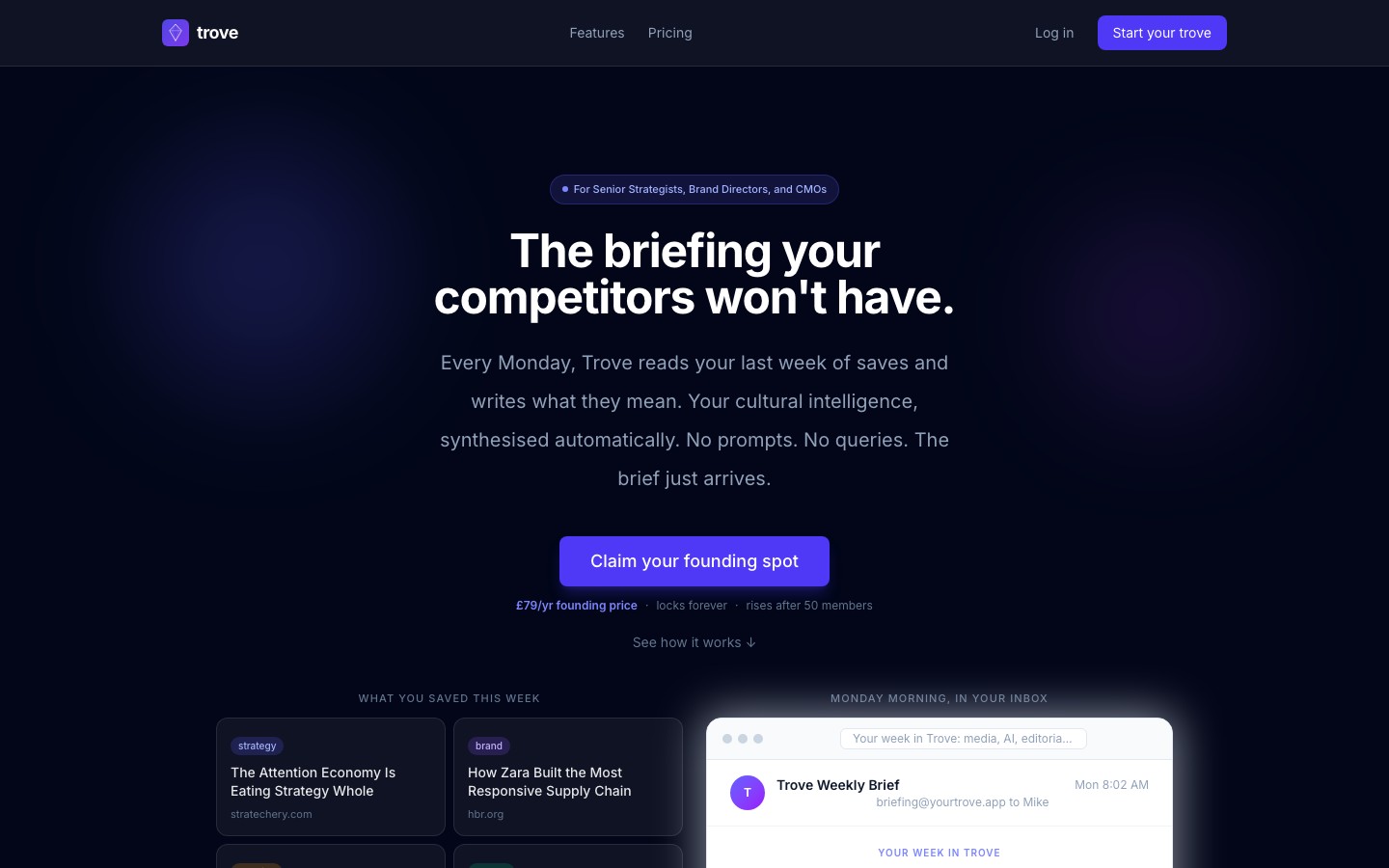
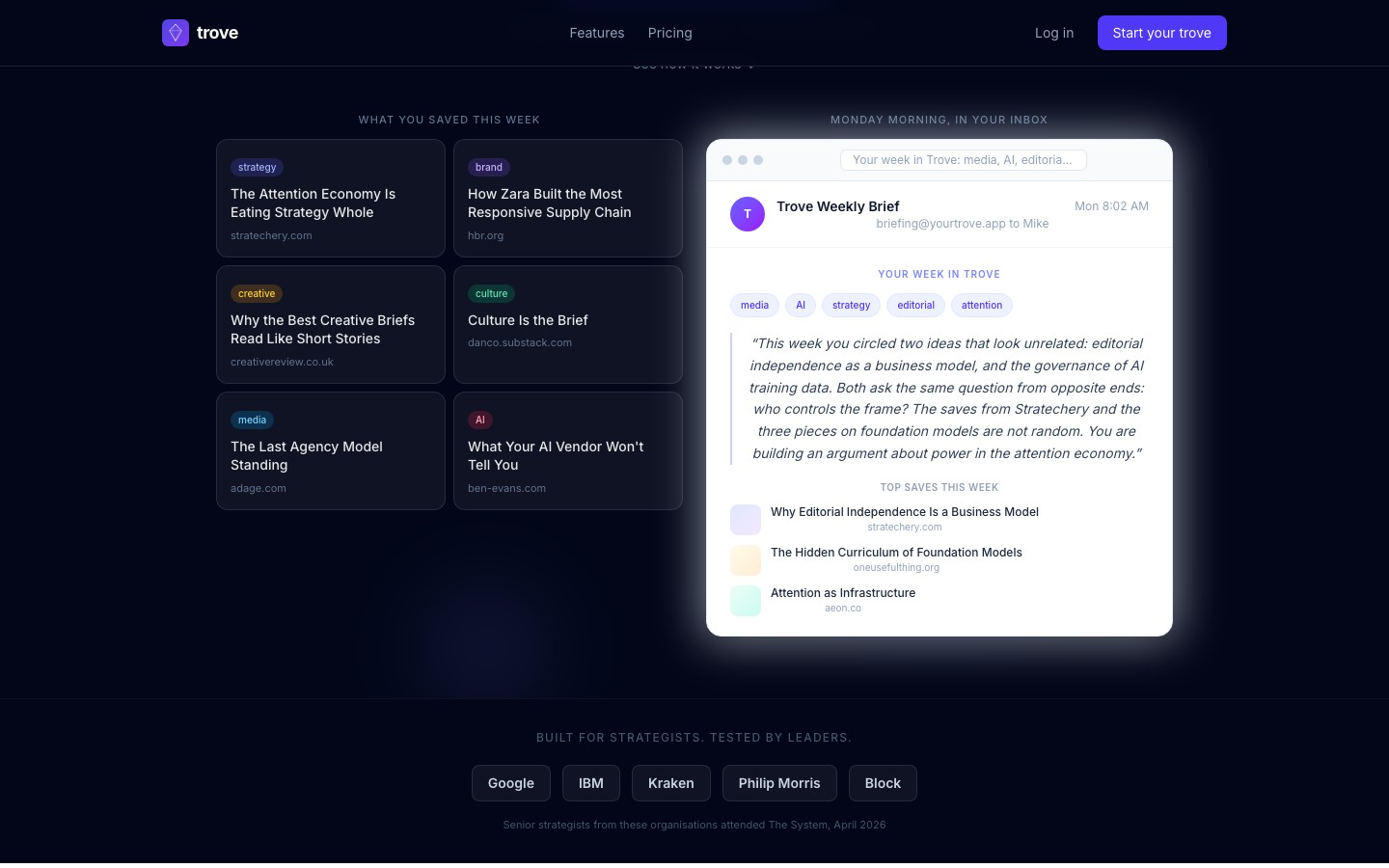
This is an example of the weekly briefing. It is written from a week of saves. The day is one the reader chooses, and the job runs at 07:00 UTC. The reader did not curate this. They just saved things.

From: Trove Weekly Brief  ·  briefing@yourtrove.app  ·  This morning Your week in Trove: media, AI, editorial…
Your week in Trove
media AI strategy editorial attention

This week you circled two ideas that look unrelated: editorial independence as a business model, and the governance of AI training data. Both ask the same question from opposite ends: who controls the frame? The saves from Stratechery and the three pieces on foundation models are not random. You are building an argument about power in the attention economy. You haven't written it yet.

Top saves this week
Why Editorial Independence Is a Business Model
stratechery.com
The Hidden Curriculum of Foundation Models
oneusefulthing.org
Attention as Infrastructure
aeon.co

An example of the weekly briefing. Illustrative, not a promise of length or send time.

What is live

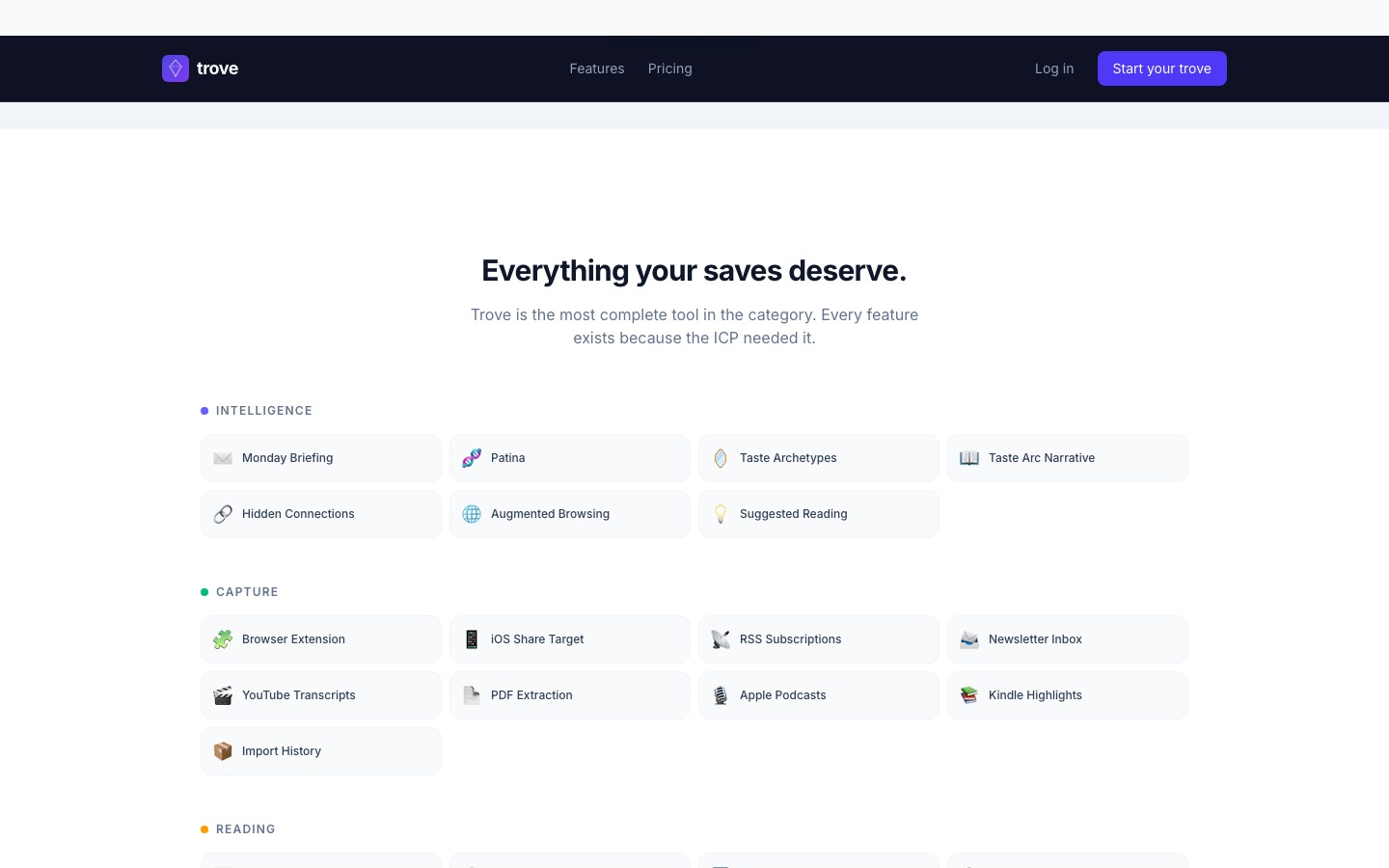
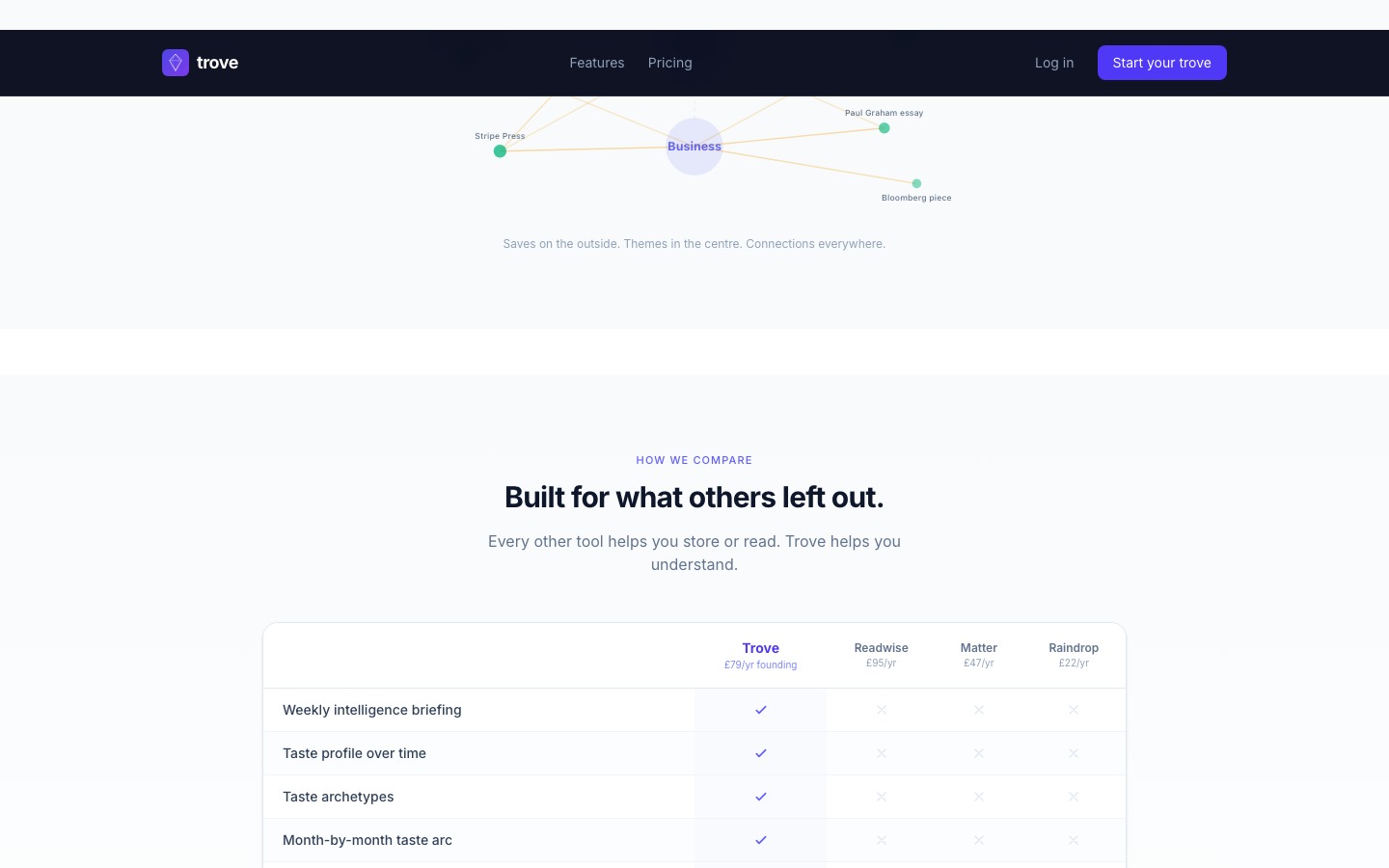
Trove does not publish a competitive score. These are the features on the public product today. Offline reading, signal radar, palettes, Same Vibe, highlight notes and review, Obsidian sync, Readwise sync, a proactive agent and an iOS app are not part of the product.

SaveArticles, images, PDFs, decks, documents, newsletters, RSS and screenshot text. A save-only iPhone Shortcut. A save API.
ReadSemantic search, intents, highlights, collections with unlisted links, a graph and Rediscover.
AskAsk the library. Claude and Cursor connect over MCP. A read-only key can search and cannot change anything.
BriefA weekly briefing on the day you choose. Patina, an insight brief, a cultural read, and Write with your library.
ListenA listen queue with a private podcast feed. YouTube captions are live. Transcripts for other audio are coming.
InImport from Matter and MyMind, and from Instapaper, Raindrop, bookmarks or Kindle highlights.

Press release

Lede option 1 · Market angle

Two tools served tens of millions of readers for over a decade. Pocket shut down in July 2025. Omnivore, the open-source reader, folded in November 2024. The infrastructure the internet used to save and revisit things is gone. A new tool called Trove arrived to argue that its replacements have been asking the wrong question all along.

Lede option 2 · Product angle

Trove is a save-it-for-later app. On the day you choose, it emails a briefing written from the articles and links you saved. Ask can also answer a question from that same library. The briefing follows the day that reader chose.

Lede option 3 · Competitive angle

Trove is a save-it-for-later app with a weekly briefing, Ask, Patina and a read-only connection for Claude and Cursor. It does not publish a competitive score. The difference, its founder argues, is what happens after you save: the library can be searched, briefed and asked, and an assistant can read it without being allowed to change it.

Draft press release / May 2026

Trove opens founding membership: a save-it-for-later library with a weekly briefing, Ask and Patina

Trove, the professional cultural intelligence tool built for Heads of Strategy and Brand Directors, has opened founding member access at £79 per year, with the price locked permanently for the first 50 members.

Trove is a save-it-for-later app. Members save articles, files, newsletters and screenshots, then get a weekly briefing on the day they choose, written from their own library. Ask answers questions from those saves. Patina shows the themes and sources they keep returning to.

What is live: briefings, Ask, Patina, semantic search, intents, highlights, a graph and Rediscover. Collections can be opened with an unlisted link. The MCP server accepts read-only keys, and there is a save API. Matter and MyMind libraries can be imported. The insight brief, the cultural read, and Write with your library are live. So are a listen queue with a private podcast feed, a newsletter and RSS inbox, file saves (images, PDFs, decks and documents), text read from screenshots, and a save-only iPhone Shortcut.

YouTube saves include captions. Transcripts for other audio are coming. Trove does not offer offline reading, a signal radar, palettes, Same Vibe, highlight notes and review, Obsidian or Readwise sync, a proactive agent, or an iOS app. It does not group readers into taste archetypes.

The launch comes as the read-later market faces structural disruption. Pocket, which had approximately 40 million users, shut down in July 2025. Omnivore, the open-source reader, folded in November 2024. Trove is a save-it-for-later app for people who want the library to stay useful after they save.

Founding membership is priced at £79 per year, locked permanently for the first 50 members. Standard pricing is £99 per year after founding allocation closes. The tool is built on Next.js 15, Supabase, and pgvector, and is available at yourtrove.app.

Trove was created and built by Michael Litman, named to the BIMA 100 as a Tech Pioneer and published author (BCS, 2024), with 15+ years in digital strategy across Nike, Google, Meta, and Unilever. The April 2026 waitlist event at The System, Litman's AI strategy programme, attracted 125+ senior registrations, with live attendees from Google, IBM, Block, Philip Morris, and Kraken.

About Trove: Trove is a professional cultural intelligence tool for Heads of Strategy, Brand Directors, and fractional CMOs. A save-it-for-later app. A weekly briefing on the day you choose, Ask, and Patina. Built by Michael Litman. Available at yourtrove.app.

Social copy

For journalists

Exclusive media offer

Founding access for the duration of your coverage, at no charge

Journalists and analysts covering the read-later, bookmarking, or professional intelligence space are welcome to full founding member access to Trove for as long as they are covering this area. That includes the weekly briefing, Patina, and the features that are live today, plus updates that ship during the coverage period. One email is all it takes.

To request access: hello@mikelitman.me with your publication or brief. Turnaround: usually within 24 hours.

Press assets

Free to use with attribution to Trove (yourtrove.app). Screenshots are 1440×900 JPEG. Higher-resolution and bespoke formats available on request.

Trove hero screenshot
Hero – above fold
1440×900 · JPEG
Download ↓
Trove saves grid and briefing email
Saves grid + briefing email
1440×900 · JPEG
Download ↓
Trove feature grid
Product screenshots
1440×900 · JPEG
Download ↓
Trove comparison table
Comparison table vs competitors
1440×900 · JPEG
Download ↓
Trove social proof strip with Google IBM Kraken Philip Morris Block
Social proof + hero feature
1440×900 · JPEG
Download ↓

About the founder

Background

Michael Litman

Founder, Trove · Cultural Capital Labs

Michael is building AI-native products at Cultural Capital Labs, founded September 2025. Trove is the product he built because he needed it himself: 15+ years of saving links compulsively, with no tool able to tell him what they meant until he built one. The weekly briefing he ships to Trove members, on a day each person chooses, is the one he has wanted for years.

Credentials
  • BIMA 100 Tech Pioneer
  • Author, AI-Assisted Design (BCS, 2024)
  • 20+ live AI-native products
  • Clients: Nike, Google, Meta, Gucci, BMW, TikTok, Netflix, Unilever
  • Agencies: R/GA, MediaMonks, Contagious, Poke, AnalogFolk
  • Based in London
  • mikelitman.me

Media contact

Founder

Michael Litman

Founder, Trove

Email

hello@mikelitman.me

Usually within 24 hours

Available for interviews, briefings, and demos

LinkedIn: linkedin.com/in/michaellitman

BIMA 100 Tech Pioneer; Published author (BCS, 2024)